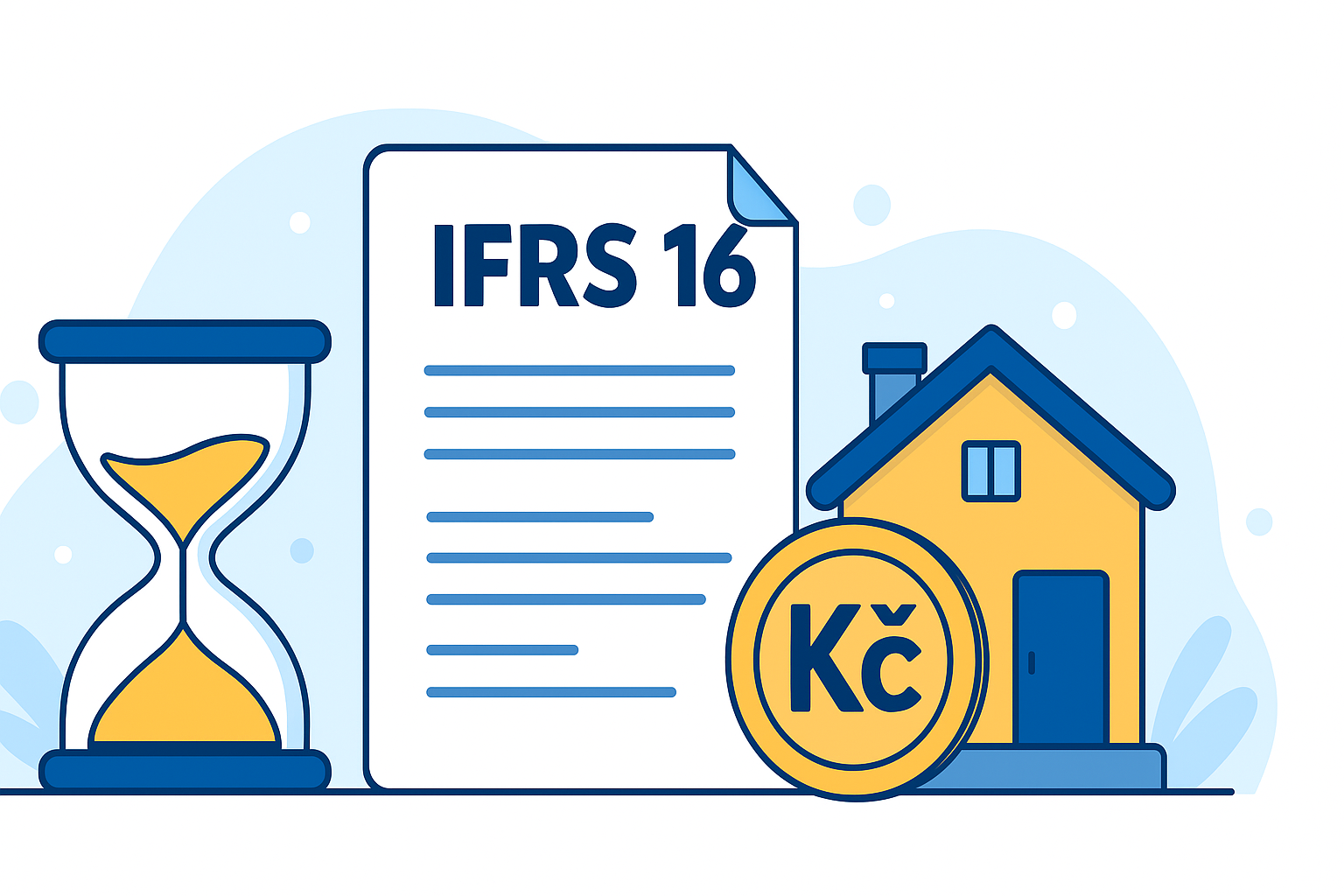

IFRS 16 - leases
 IFRS 16 is an inconspicuous standard that most people in the Czech Republic do not even know. However, this will change very quickly with the new Accounting Act, which is likely to be effective from 1 January 2027. The new Accounting Act basically implements this standard into Czech accounting. What's more, under current assumptions, costs under this standard will also be tax costs under the Income Tax Act.
The IFRS 16 standard according to the International Financial Reporting Standards (IFRS) is effective as of 1 January 2019 for companies reporting under IFRS. In the Czech Republic, it will be fully applicable to medium and large entities. However, micro and small accounting units will also have to account according to it with some simplification - they will not have to discount, i.e. take into account the time value of money according to IFRS.
So what's the point? IFRS 16 applies not only to leases in the sense of finance leases, but to any long-term leases (other than leases with a small asset value). I.e. imagine you are renting an office and you have a 10 year lease and you are paying 1 mio CZK per year. In simple terms, IFRS 16 tells you that you have to report 10 x 1 million CZK to assets and to liabilities. The 10 million have to be discounted (apparently it will apply only to medium and large accounting units in the Czech Republic). An asset of 10 million is depreciated and the liability is payed off and an interest is booked.
ost systems are not ready for this process and even SAP had big problems with it. Jiří Jirka has been working on this accounting procedure in detail since 2017 and together with his colleagues he invented the IFRS 16 accounting system at CSOB. MS ExcelWe therefore have extensive experience in setting up the process and system according to this standard.
 We can also process contracts and calculate values outside the system (in excel) and prepare accounting entries for the actual accounting in the system. We recommend this solution especially for simple contracts, because in the case of more complex contracts with frequent changes it is quite challenging.